Overview
Arbitrage with CrossEx is a free, open-source tool built by the Pendle team that lets traders run a cross-exchange funding-rate arbitrage through Gate CrossEx and Boros, from a single dashboard on their own machine.
It runs locally — there's nothing to sign up for on the app itself. It talks directly to your own Gate account and your own Boros wallet.
Learn more and get started at boros.pendle.finance/arbitrage-crossex.
The strategy: cross-exchange funding rate arbitrage
The same coin's funding rate often differs between venues. For example, BTC funding might be priced at 8% APR on Hyperliquid and 4% APR on Binance. The strategy locks in that 4% gap as a fixed yield.
Every position has two halves, both at the same notional:
- The perp pair (via CrossEx): short the perp on the higher-funding venue and long the perp on the lower-funding venue. The two perps cancel each other's price exposure, and together they collect the floating funding gap.
- The rate lock (on Boros): pay that floating gap away on Boros in exchange for a fixed rate. What remains is a fixed return until the Boros market matures.
Boros offers two ways to lock the rate. When a Spread Market exists for the venue pair, the terminal always uses it, since it needs less margin and has deeper liquidity. Two Funding Market legs are used only for pairs without one.
Option 1: Short a Spread Market (3 legs)
If Boros lists a Spread Market for the venue pair, the whole rate lock is one position. Using BTC Spread HL-Gate as an example:
- Short 10 YU of BTC Spread HL-Gate at 4% Implied APR (Boros)
- Short 10 BTC on Hyperliquid BTC perp (via CrossEx)
- Long 10 BTC on Gate BTC perp (via CrossEx)
The Boros side is a single order, with one margin requirement and one liquidation implied APR, both based on the spread itself. A move in either venue's funding rate cannot liquidate you on its own. Only a move in the spread can.
Option 2: Two Funding Market legs (4 legs)
For any venue pair without a Spread Market, the rate lock is built from two Funding Market positions. Using BTC on Hyperliquid and Binance:
- Short 10 YU of BTC Hyperliquid funding at 8% Implied APR (Boros)
- Long 10 YU of BTC Binance funding at 4% Implied APR (Boros)
- Short 10 BTC on Hyperliquid BTC perp (via CrossEx)
- Long 10 BTC on Binance BTC perp (via CrossEx)
This works for any two markets that share a collateral and maturity. The Boros side is then two positions, each with its own margin and its own liquidation level.
Either way, the trader is delta-neutral and holds just the 4% APR spread as fixed yield until the Boros market matures (before leverage).
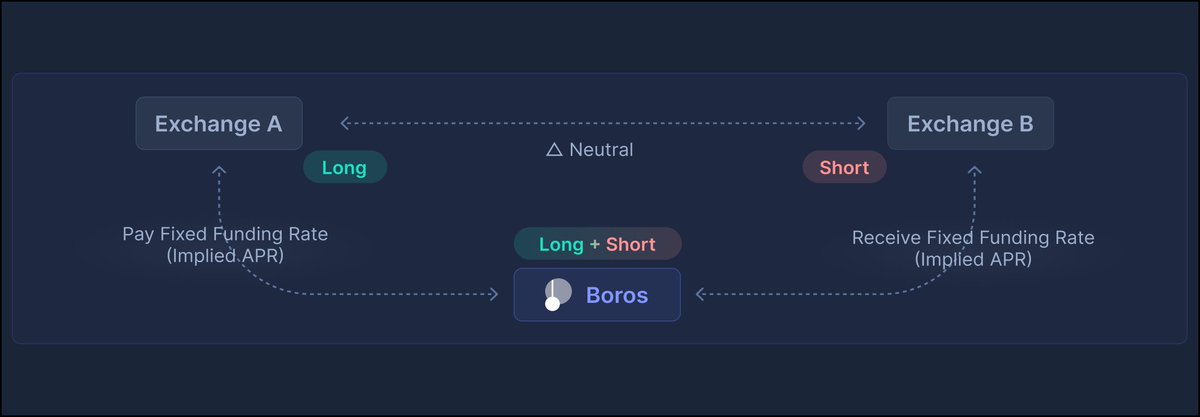
With leverage, this can be a lucrative yield farm — but coordinating collateral and positions across multiple exchanges manually is clunky, which is what keeps most traders from running it.
Why CrossEx
CrossEx is a Gate.io product that gives traders unified margin across perp positions opened on multiple exchanges simultaneously. Instead of juggling separate collateral pools per venue, a trader can open the long/short perp legs of the arbitrage under one account and remain fully delta-neutral.
What the app does
Arbitrage with CrossEx integrates both CrossEx and Boros so a trader can:
- Scan opportunities — see live fixed-rate spreads across venues, with potential returns and required margin calculated automatically
- Execute every leg — a guided wizard locks the fixed rate on Boros (one Spread Market order, or two Funding Market orders), then hedges the perp legs through CrossEx, without leaving the dashboard
- Monitor margin, PnL, and yield across the whole position from a single dashboard, with a full breakdown of every cost charged against the return
This is experimental, open-source software that places real orders with real funds on your own exchange account. It is not financial, investment, legal, or tax advice. See Risks & Security before use.
Further reading
- Spread Markets on Boros
- Understanding Implied and Underlying APR on Boros
- How Boros enables fixed rate payments on floating funding rates
- How Boros enables receiving fixed rates on floating funding rates
- Fixed-Return Funding Arbitrage — Boros Academy
Next: Installation